
Dry Ice Blasting Explained: Benefits for Industrial Cleaning

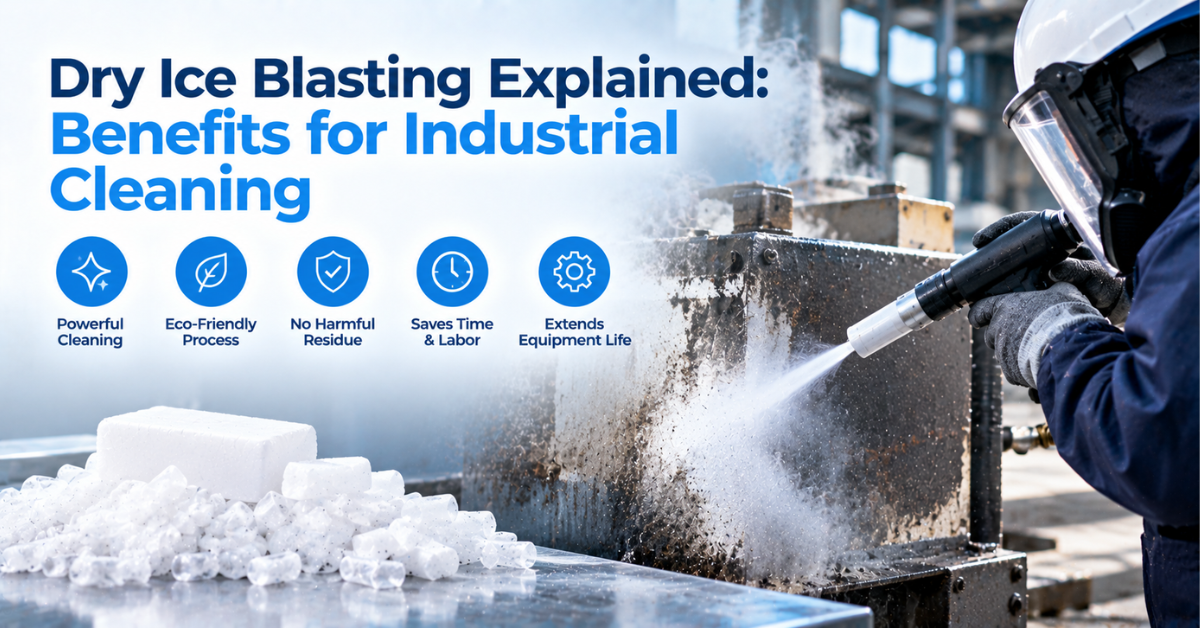
Industrial cleaning has always been a balancing act. Facilities need equipment that is spotless, safe, and running efficiently, but traditional cleaning methods often create as many problems as they solve. Sandblasting can damage surfaces, chemical cleaners create hazardous waste, and water-based cleaning can be a problem around electrical equipment. Dry ice blasting has emerged as a modern alternative, and it is increasingly popular with manufacturers, food processors, power plants, and maintenance teams across the UAE.
This guide explains what dry ice blasting is, how it works, what makes it different from other cleaning methods, and what businesses should consider before adopting it, including how to source quality dry ice pellets and how to keep operators safe.
What Is Dry Ice Blasting?
Dry ice blasting is a cleaning method that uses small pellets of solid carbon dioxide, propelled at high speed by compressed air, to remove contaminants from surfaces. It works somewhat like sandblasting or soda blasting, but the blasting media is dry ice at approximately -78.5°C, which turns into gas on impact instead of remaining behind as waste.
Because the pellets sublimate as soon as they strike the surface, the only material left to clean up is the contaminant that has been removed. There is no sand, grit, or water to collect, which is the feature that makes the process so attractive for industrial environments.
How Dry Ice Blasting Works
Three effects work together to clean a surface during dry ice blasting:
- Kinetic energy: the pellets strike the surface at high speed, dislodging loose contaminants.
- Thermal shock: the extreme cold makes the contaminant brittle and causes it to contract, weakening its bond with the surface underneath.
- Gas expansion: as the pellets sublimate on impact, the rapid expansion of CO2 gas lifts the contaminant away from the surface.
The result is a thorough clean that typically leaves the underlying surface intact, without abrasion, moisture, or chemical residue.
Key Benefits of Dry Ice Blasting
No Secondary Waste
Since the dry ice converts to gas, the only waste is the removed contamination. This reduces cleanup time and the cost of disposing of used blasting media.
Non-Abrasive and Gentle on Equipment
Dry ice blasting cleans without wearing down surfaces, so delicate molds, precision components, and expensive machinery are far less likely to be damaged than with abrasive methods.
Cleaning Without Dismantling
Many machines can be cleaned in place while they are still warm, avoiding lengthy disassembly and reducing downtime. For production facilities, less downtime means more output.
Dry and Electrically Safe
There is no water involved, so dry ice blasting can be used on many types of electrical equipment, motors, and control panels, provided the correct safety procedures are followed.
Environmentally Responsible
The process does not require harsh solvents or chemicals, and it produces no toxic runoff. Businesses working toward greener operations often find it fits well with their sustainability goals.
Improved Hygiene
In food and beverage production, dry ice blasting can help remove grease, residue, and buildup without introducing moisture, which is important for controlling bacterial growth.
Industries That Use Dry Ice Blasting
- Food and beverage manufacturing: cleaning ovens, conveyors, mixers, and packaging lines
- Automotive and aerospace: removing paint, grease, and residue from components and tooling
- Power generation and utilities: cleaning turbines, generators, and electrical equipment
- Oil, gas, and petrochemical: removing buildup from machinery and industrial surfaces
- Plastics, rubber, and manufacturing: cleaning molds without damaging them
- Printing and packaging: removing ink and adhesive buildup from rollers and machinery
- Building restoration and heritage work: gently cleaning delicate surfaces and removing graffiti or soot
- Marine and shipping: cleaning engine parts and equipment
Dry Ice Blasting vs Other Cleaning Methods
- Vs sandblasting: sand is abrasive and creates large amounts of waste and dust, while dry ice is non-abrasive and leaves no media behind.
- Vs water blasting: water can damage electrical equipment and leaves surfaces wet, while dry ice is dry and suitable for many electrical applications.
- Vs chemical cleaning: chemicals require careful handling and disposal, while dry ice blasting avoids solvents entirely.
- Vs manual scrubbing: manual methods are slow, labor-intensive, and often miss hard-to-reach areas, while blasting cleans quickly and reaches intricate surfaces.
Dry ice blasting is not the right answer for every job. Very heavy, thick coatings may be more efficiently removed with other methods, and the initial equipment investment or service cost should be weighed against the savings in downtime and labor. But for many maintenance and cleaning tasks, it offers a compelling combination of speed, safety, and cleanliness.
Dry Ice Pellets: Why Quality and Freshness Matter
The effectiveness of blasting depends heavily on the dry ice itself. Blasting pellets are typically small and dense, and they should be fresh, consistent in size, and well stored. Pellets that have partly sublimated become smaller and less effective, which reduces cleaning power and increases the amount of dry ice you need.
This is why dry ice blasting depends so heavily on supplier reliability. Businesses that run blasting equipment need predictable, fresh deliveries timed to their cleaning schedules, with the right pellet size for their equipment. In a hot climate like the UAE, where sublimation is faster, freshness matters even more.
Safety Considerations for Dry Ice Blasting
Dry ice blasting is safe when done properly, but operators and supervisors should be aware of the main hazards:
- CO2 buildup: blasting releases large amounts of carbon dioxide gas. Work areas must be well ventilated, and in confined spaces CO2 monitoring is strongly advised.
- Noise: blasting equipment can be loud, so hearing protection is essential.
- Extreme cold: operators must wear insulated gloves to protect against cold burns.
- Eye and face protection: safety glasses or a face shield should always be worn to protect from flying debris and pellets.
- Training: operators should be trained in equipment use, dry ice handling, and emergency procedures.
- Storage: dry ice pellets must be stored in insulated, ventilated containers, never sealed containers.
What to Consider Before Adopting Dry Ice Blasting
- Your cleaning needs: what contaminants are you removing, and from what surfaces?
- Equipment options: buy, rent, or use a specialist contractor depending on how often you will blast
- Dry ice supply: how will you secure fresh pellets on a regular basis?
- Site conditions: ventilation, access, and safety requirements in your facility
- Operator training and safety procedures
- Total cost of ownership, including downtime savings, labor, and disposal costs avoided
Sourcing Dry Ice for Blasting in the UAE
A dependable dry ice supply is the foundation of any blasting operation. When choosing a supplier, look for consistent quality, correct pellet sizing for your equipment, reliable scheduled delivery, and the ability to scale volumes up during shutdowns or major maintenance periods.
Ice Dry Ice, a Dubai-based supplier, serves businesses across the UAE that depend on regular dry ice deliveries. For facilities planning a blasting program, discussing your requirements, pellet specifications, and delivery schedule with an established local supplier helps ensure that your equipment is never sitting idle waiting for material.
Getting Started: A Practical Checklist for Facilities
Facilities new to dry ice blasting can avoid most early problems by preparing properly. Before your first cleaning session, work through these practical steps:
- Identify the equipment and surfaces to be cleaned, and the type of contamination involved
- Run a small test area to confirm that the settings and pellet size give the results you want
- Prepare the site by ensuring ventilation, clearing the work area, and protecting anything sensitive
- Arrange fresh pellet delivery for the morning of the job, rather than the day before
- Confirm that operators have proper training and protective equipment
- Plan for a slightly larger pellet quantity than the minimum, since the first job often uses more as settings are fine-tuned
Following a checklist like this turns dry ice blasting from a one-off experiment into a repeatable maintenance process, which is where the biggest savings appear over time.
Frequently Asked Questions
Does dry ice blasting damage surfaces?
It is considered non-abrasive and is generally gentler than sand or grit blasting. Settings can be adjusted for delicate surfaces, but operators should always test on a small area first.
Is dry ice blasting safe for electrical equipment?
Because it is dry and non-conductive, it is widely used on electrical equipment, but the correct procedures must be followed and the manufacturer’s guidance considered.
How long do dry ice pellets last?
Pellets sublimate quickly, so they are best used soon after delivery. Storage in an insulated container slows the process but does not stop it.
Can dry ice blasting be done in confined spaces?
Only with extreme caution. CO2 can accumulate and displace oxygen, so confined spaces require ventilation and gas monitoring, and should only be worked in by trained personnel.
Final Thoughts
Dry ice blasting offers UAE industries a fast, clean, and environmentally responsible way to keep equipment in top condition, without abrasion, water, or chemical waste. Its benefits are strongest when it is paired with correct safety practices and a dependable supply of fresh dry ice pellets.
If your business is considering dry ice blasting, or already relies on it, working with a reliable partner like Ice Dry Ice can help keep your cleaning schedule on track and your operation running smoothly.