
Liquid Nitrogen for Cryopreservation: Applications in Labs and Livestock

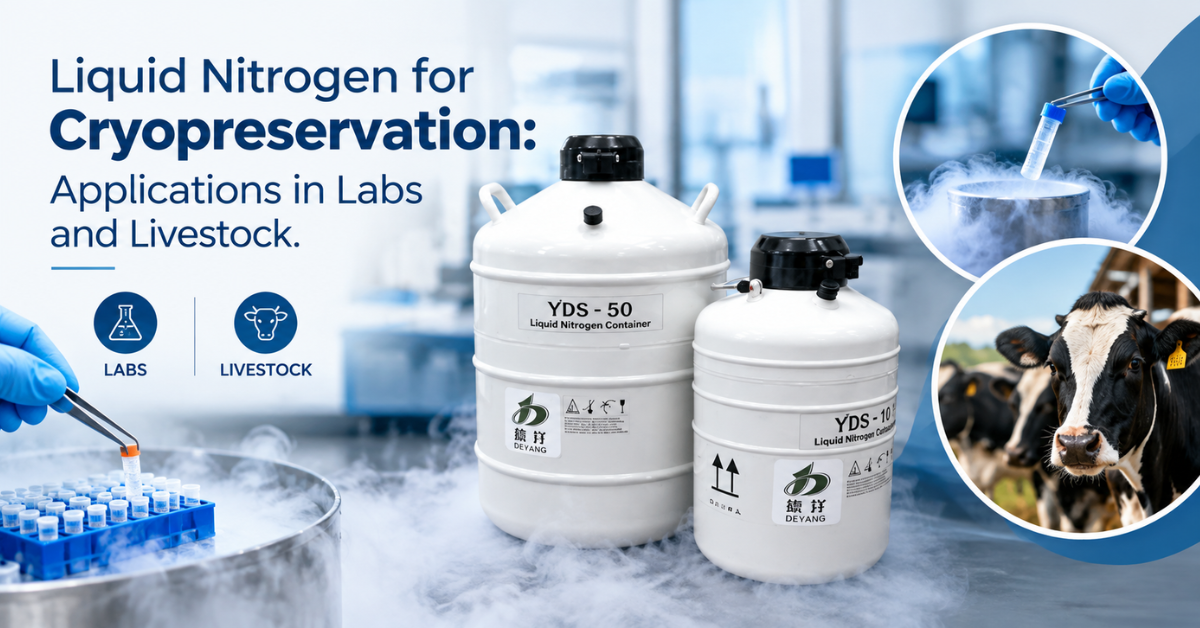
Cryopreservation, the practice of preserving biological material at extremely low temperatures, has become foundational to modern science, medicine, and agriculture. From research laboratories studying cell biology to livestock breeding centers safeguarding valuable genetics, liquid nitrogen for cryopreservation is the technology that makes long-term, reliable biological storage possible. In the UAE, where both scientific research and agricultural innovation continue to expand, understanding how cryopreservation works, and how to manage it properly, has become increasingly important.
This guide explores how liquid nitrogen supports cryopreservation across laboratory and livestock applications, the science behind the process, and what organizations should know about handling, storage, and sourcing liquid nitrogen reliably.
What Is Cryopreservation?
Cryopreservation is the process of cooling biological material, such as cells, tissues, or reproductive material, to extremely low temperatures in order to halt biological activity and preserve it for future use. At temperatures around -196°C, the temperature of liquid nitrogen, the chemical and biological processes that cause degradation slow to a near standstill, allowing samples to remain viable for extended periods, sometimes decades, when stored correctly.
Why Liquid Nitrogen Is the Standard for Cryopreservation
Liquid nitrogen offers a combination of properties that make it ideal for this purpose. It reaches a temperature low enough to effectively stop biological activity, it is relatively straightforward to produce and transport compared with maintaining mechanical ultra-low freezers everywhere storage is needed, and it is inert, meaning it does not react with or contaminate the stored material. These factors have made it the standard cooling medium for cryopreservation across research, medical, and agricultural settings worldwide.
Laboratory Applications of Liquid Nitrogen Cryopreservation
Cell Line and Tissue Storage
Research laboratories routinely preserve cell lines, allowing researchers to maintain stable, consistent biological material for experiments over long periods without the risk of genetic drift that can occur in continuously cultured cells.
Biobanking
Hospitals and research institutions use cryopreservation to store tissue, blood, and other biological samples for future research, diagnostics, or treatment purposes, building valuable long-term sample collections known as biobanks.
Reproductive Material Storage
Fertility clinics and research facilities use liquid nitrogen cryopreservation to store reproductive cells and embryos, supporting both medical treatment programs and broader research into reproductive biology.
Pharmaceutical and Vaccine Research
Some pharmaceutical development and vaccine research processes depend on cryopreserved biological materials as part of testing, development, or production workflows, where consistency and long-term viability of samples is essential.
Livestock and Agricultural Applications
Semen and Embryo Storage
As with reproductive research, livestock breeding programs rely heavily on liquid nitrogen cryopreservation to store semen and embryos, enabling structured breeding programs, artificial insemination, and the preservation of valuable genetic lines across time and distance.
Genetic Diversity Preservation
Cryopreservation allows breeding programs and conservation projects to preserve genetic diversity by storing material from a wide range of animals, protecting against the loss of valuable bloodlines and supporting long-term breeding strategy.
Veterinary Research
Veterinary research institutions use cryopreserved samples to study animal health, reproduction, and disease, supporting advances that benefit both commercial livestock operations and conservation efforts.
How Cryopreservation Storage Systems Work
Samples are typically stored in specialized cryogenic tanks, either submerged directly in liquid nitrogen or held in the nitrogen vapor phase above the liquid, depending on the storage system and the sensitivity of the material. Vapor phase storage is often preferred for certain biological materials because it avoids potential cross-contamination between samples that can occur with direct liquid immersion, while still maintaining extremely low, stable temperatures.
- Storage tanks must maintain a continuous, stable temperature with no significant fluctuation
- Liquid nitrogen levels require regular monitoring to prevent samples from warming beyond safe limits
- Detailed record-keeping tracks sample location, storage date, and any relevant identifying information
- Backup power or supply arrangements help protect against unexpected equipment failure or delivery delays
The Critical Importance of Consistent Supply
For any organization relying on cryopreservation, whether a research laboratory or a livestock breeding center, a gap in liquid nitrogen supply poses a direct threat to stored material. Unlike many operational disruptions that can be resolved after the fact, the loss of cryopreserved samples due to warming is often permanent and irreversible. This makes dependable liquid nitrogen delivery one of the most important operational priorities for any organization doing this kind of work.
Best Practices for Cryopreservation Facilities
- Establish a reliable, scheduled liquid nitrogen delivery arrangement well ahead of when tank levels become critical
- Use properly designed cryopreservation storage tanks suited to your specific sample types
- Implement regular monitoring procedures, including level checks and temperature verification
- Maintain detailed, accurate records for every stored sample
- Train staff thoroughly in correct handling, monitoring, and emergency procedures
- Build in backup supply arrangements or buffer stock to protect against unexpected delivery delays
Safety Considerations in Cryopreservation Facilities
Facilities handling liquid nitrogen for cryopreservation should follow the same core safety principles as any other liquid nitrogen application: proper ventilation to prevent oxygen displacement, appropriate protective equipment for staff handling tanks and samples, oxygen monitoring in enclosed storage rooms, and clear emergency procedures for spills or equipment failure. Given the value and sensitivity of the stored material, many facilities also implement additional monitoring and alarm systems specifically to protect against storage failures.
Choosing a Liquid Nitrogen Supplier for Cryopreservation
Laboratories and breeding centers need a supplier who understands the critical nature of their work and can provide consistent purity, dependable scheduling, and genuine responsiveness if urgent supply is ever needed. Given how much is often at stake in a single storage tank, supplier reliability deserves the same careful evaluation as any other piece of critical infrastructure.
Ice Dry Ice supplies liquid nitrogen to laboratories, research facilities, and livestock breeding operations across Dubai and the UAE, with a focus on dependable, well-timed delivery that supports the continuous cold chain these applications require. For organizations where sample loss is simply not an acceptable outcome, working with a supplier who treats every delivery with appropriate seriousness makes a meaningful difference.
The Growing Role of Cryopreservation in UAE Research
As the UAE continues to invest in scientific research, healthcare innovation, and agricultural development, cryopreservation capacity has become an increasingly important part of the supporting infrastructure. Universities, hospitals, and specialized research centers are expanding their use of long-term biological storage, which in turn increases demand for dependable liquid nitrogen supply chains able to support critical, uninterrupted cold storage.
Disaster Planning for Cryopreservation Facilities
Because the consequences of a cryopreservation failure can be so severe, many facilities build disaster planning into their operations, including backup liquid nitrogen supply arrangements, alarm systems that alert staff outside normal working hours, and clear emergency response protocols. Discussing these contingency plans with your liquid nitrogen supplier in advance, rather than only after a problem occurs, helps ensure a fast, coordinated response if the unexpected happens.
Balancing Cost and Risk in Cryopreservation Storage
Organizations managing cryopreserved material often face a balance between minimizing ongoing storage costs and protecting against the risk of sample loss. While it may be tempting to reduce costs by ordering the minimum liquid nitrogen required, most experienced facilities choose to build in a reasonable buffer, since the cost of a missed or delayed delivery is almost always far higher than the cost of slightly conservative ordering. Treating liquid nitrogen supply as critical infrastructure, rather than a routine purchase, reflects the true value of what is being stored.
The Role of Documentation in Regulatory Compliance
Many cryopreservation applications, particularly in healthcare, pharmaceutical research, and certain livestock breeding programs, fall under specific regulatory or industry standards governing how biological material must be stored, documented, and traced. Maintaining thorough records of storage conditions, delivery dates, and liquid nitrogen levels not only protects sample viability but also supports compliance during audits or inspections. Facilities should ensure their liquid nitrogen supplier can provide clear delivery documentation and consistent service records, since these often form part of the broader compliance picture for regulated cryopreservation work.
Frequently Asked Questions
How long can samples remain viable in cryopreservation?
With proper, continuous storage at the correct temperature, many biological materials can remain viable for years or even decades, though viability varies depending on the type of material and storage method.
What is the difference between liquid phase and vapor phase storage?
Liquid phase storage submerges samples directly in liquid nitrogen, while vapor phase storage keeps samples in the cold nitrogen gas above the liquid, which some facilities prefer to reduce the risk of cross-contamination between samples.
What happens if a cryopreservation tank fails?
If samples warm beyond the required temperature, their viability can be permanently compromised or lost, which is why monitoring systems, backup supply, and rapid response procedures are so important.
Do laboratories need specialized training for cryopreservation storage?
Yes. Staff should be trained in safe liquid nitrogen handling, correct sample storage and retrieval procedures, and monitoring protocols specific to the facility’s storage systems.
Final Thoughts
Liquid nitrogen cryopreservation underpins critical work across laboratories, hospitals, and livestock breeding operations throughout the UAE, preserving material that is often irreplaceable. The science is well established, but its success in practice depends heavily on consistent supply, proper equipment, and careful handling.
Organizations that treat their liquid nitrogen supply as a critical operational priority, and that partner with a dependable local supplier such as Ice Dry Ice, give their cryopreservation programs the strongest possible foundation for long-term success.