
Top Industrial Uses of Liquid Nitrogen You Should Know

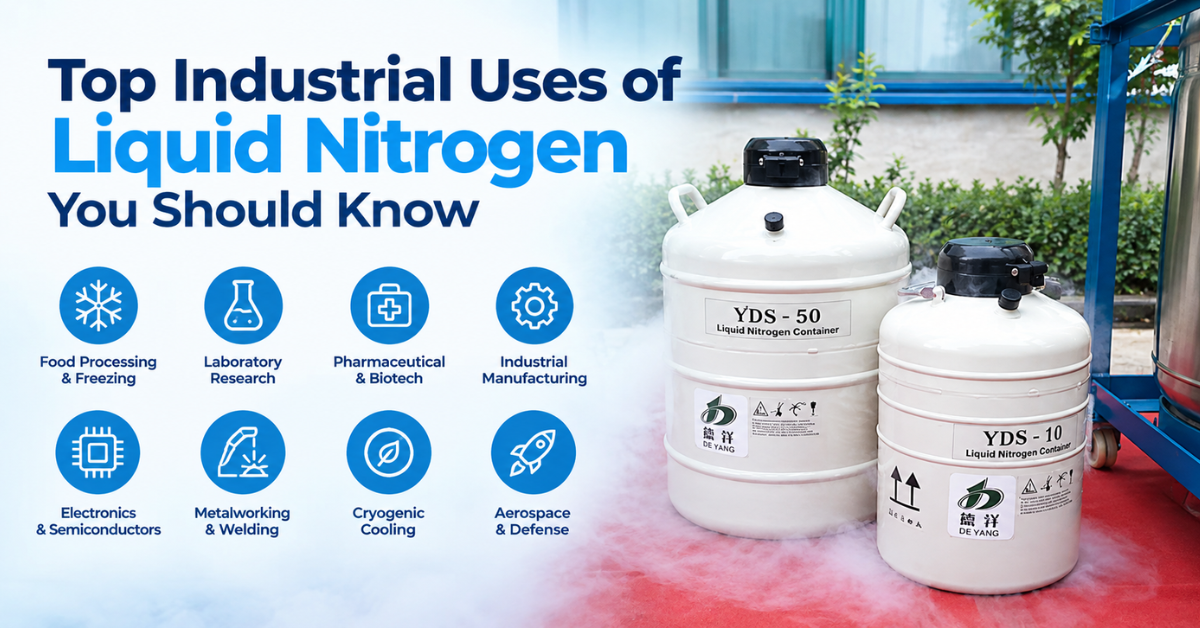
Liquid nitrogen rarely gets the attention it deserves, considering how many industries quietly depend on it. Because it is inert, extremely cold, and widely available, it has become one of the most versatile industrial materials in use today. Across the UAE, liquid nitrogen plays a role in food processing plants, manufacturing facilities, construction sites, laboratories, and even the maintenance teams that keep machinery running.
This guide walks through the top industrial uses of liquid nitrogen, explains the properties that make it so useful, and offers practical guidance for UAE businesses considering it for the first time, including what to look for in a reliable supplier.
What Makes Liquid Nitrogen So Useful Industrially
Liquid nitrogen is produced by cooling nitrogen gas, which makes up most of the air around us, down to about -196°C. At that temperature it becomes a liquid, and it is inert, meaning it does not react with most materials, is non-flammable, and leaves no residue when it evaporates. These properties, combined with its extremely low temperature, make it valuable wherever a process needs intense cold, an oxygen-free environment, or both.
1. Food Freezing and Processing
One of the most widespread industrial uses of liquid nitrogen is cryogenic freezing of food. Because it is so cold, liquid nitrogen can freeze food far faster than mechanical freezers. This rapid freezing forms smaller ice crystals inside the food, which helps preserve texture, flavor, and nutritional quality better than slower freezing methods. It is used for freezing seafood, meat, bakery products, prepared meals, and increasingly for individually quick frozen fruits and vegetables exported through the UAE’s busy trade routes.
2. Food and Beverage Packaging
Beyond freezing, liquid nitrogen is used to create a protective inert atmosphere inside sealed food and beverage packaging. A small amount is dosed into a container just before sealing, where it vaporizes and displaces oxygen, helping to extend shelf life and protect products such as bottled drinks, snack packaging, and certain fresh produce packs from oxidation.
3. Cryogenic Grinding and Material Processing
Some materials, particularly plastics and rubber, become brittle when chilled to extremely low temperatures, which makes them easier to grind into fine powders without the excess heat that normal grinding generates. Liquid nitrogen cooling is used in recycling operations and manufacturing processes that need to break down materials cleanly and efficiently.
4. Metal Treatment and Manufacturing
In metalworking, liquid nitrogen is used for cryogenic treatment of metal parts, a process that can improve hardness, wear resistance, and dimensional stability in certain tools and components. It is also used to shrink-fit metal parts together, where a component is cooled so it contracts slightly, allowing it to be inserted into another part before warming and expanding into a tight, permanent fit, all without heat or welding.
5. Electronics Manufacturing and Testing
Electronic components are often tested under extreme temperature conditions to confirm they will perform reliably in real-world environments. Liquid nitrogen is used to rapidly cool components and circuit boards during stress testing, helping manufacturers identify weaknesses before products reach the market.
6. Construction and Ground Freezing
In construction and civil engineering, liquid nitrogen can be used to freeze unstable or waterlogged soil temporarily, creating a solid barrier that allows safe excavation or tunneling work to proceed. This ground freezing technique is particularly valuable on projects where traditional stabilization methods are impractical or too slow.
7. Transport and Cold Chain Logistics
While dry ice is more common for smaller parcel shipments, liquid nitrogen is widely used in larger-scale cryogenic transport systems, including specialized tankers and cryogenic shipping containers, for moving frozen food products and other temperature-sensitive cargo across long distances without relying solely on mechanical refrigeration.
8. Laboratory and Research Applications
Laboratories across the UAE use liquid nitrogen for sample preservation, cryogenic storage of biological materials, and a wide range of experiments that require extremely low temperatures. It is a staple in research facilities, hospitals, and university labs working with cell cultures, tissue samples, and other temperature-sensitive materials.
9. Fire Suppression and Inerting
Because nitrogen gas does not support combustion, it is used in some industrial settings to displace oxygen inside tanks, pipelines, and enclosed systems, reducing fire and explosion risk during maintenance or storage of flammable materials.
10. Rubber, Tire, and Deflashing Operations
Manufacturers use liquid nitrogen to chill rubber components so that excess material, known as flash, becomes brittle and can be removed cleanly through tumbling or blasting, producing a cleaner finished part without damaging the underlying material.
Why UAE Industries Are Increasing Their Use of Liquid Nitrogen
The UAE’s position as a manufacturing, trade, and food processing hub, combined with its challenging climate, has driven steady growth in demand for liquid nitrogen across sectors. Businesses are increasingly looking for processes that offer precision, speed, and consistency, all qualities that liquid nitrogen delivers reliably compared with many traditional alternatives.
What Businesses Should Consider Before Adopting Liquid Nitrogen
- The specific temperature and process requirements of your application
- Whether you need regular bulk deliveries or periodic smaller amounts
- Storage infrastructure, including appropriate cryogenic tanks or dewars
- Staff training in safe handling and emergency procedures
- Ventilation requirements for any enclosed space where liquid nitrogen is used or stored
Choosing a Liquid Nitrogen Supplier for Industrial Use
Industrial users need a supplier who can deliver consistent purity, appropriate container sizes, and dependable scheduling, since many processes run continuously and cannot tolerate supply gaps. It is worth asking about delivery frequency, emergency support, and whether the supplier has experience serving your specific industry.
Ice Dry Ice supplies liquid nitrogen to businesses across Dubai and the UAE, supporting applications from food processing to manufacturing and research. For companies integrating liquid nitrogen into a production process for the first time, working with a supplier who can advise on quantities, storage, and delivery scheduling helps avoid the early mistakes that often come with a new cryogenic process.
How Businesses Decide Whether Liquid Nitrogen Fits Their Process
Not every business needs liquid nitrogen, and deciding whether it fits a particular process usually comes down to a few practical questions: does the application need extremely low temperatures faster than mechanical refrigeration can achieve, would an inert, oxygen-free environment improve product quality or safety, and can the facility support the ventilation and storage requirements involved. Businesses that answer yes to these questions often find that liquid nitrogen delivers noticeable improvements in speed, consistency, or product quality compared with their previous process.
Getting Started With Liquid Nitrogen in a New Process
Businesses introducing liquid nitrogen for the first time generally benefit from starting with a trial run on a small scale before committing to full production changes. This allows teams to test temperature settings, measure actual consumption, and train staff in a lower-pressure environment before liquid nitrogen becomes a core part of daily operations. A supplier experienced in your industry can often advise on realistic starting quantities and help you avoid common early mistakes.
Environmental and Efficiency Benefits Across These Applications
Beyond speed and precision, many of the industrial uses described above also bring efficiency benefits that matter to UAE businesses managing energy costs and sustainability goals. Cryogenic freezing, for example, often uses less overall energy per unit of product than slower mechanical systems running continuously, while ground freezing in construction can reduce the need for more disruptive stabilization methods. As more industries look for processes that balance performance with resource efficiency, liquid nitrogen continues to find new applications beyond its traditional industrial roles.
Comparing Liquid Nitrogen to Mechanical Refrigeration for Industrial Processes
Many facilities weighing whether to adopt liquid nitrogen compare it directly against upgrading or expanding mechanical refrigeration capacity. Mechanical systems can be reliable for steady, predictable cooling loads, but they often struggle to match the speed of cryogenic freezing and typically require significant capital investment, ongoing maintenance, and ongoing energy use even when running at partial capacity. Liquid nitrogen systems, by contrast, scale more flexibly with demand, since consumption is tied directly to usage rather than a fixed piece of equipment running continuously. For businesses with seasonal or variable production volumes, this flexibility can be a meaningful operational advantage.
Frequently Asked Questions
Is liquid nitrogen safe for industrial use?
Yes, when handled according to proper safety procedures, including ventilation, protective equipment, and staff training. Its extreme cold and oxygen displacement are the main hazards to manage.
How is liquid nitrogen different from dry ice for industrial use?
Liquid nitrogen is colder, at about -196°C compared with roughly -78.5°C for dry ice, and is typically used for continuous processes or bulk freezing, while dry ice is often more practical for shipping and smaller-scale cooling tasks.
Can liquid nitrogen be stored for long periods?
It can be stored in proper cryogenic tanks for extended periods, though it gradually evaporates over time even in well-insulated containers, a process known as boil-off.
What industries in the UAE use the most liquid nitrogen?
Food processing, manufacturing, construction, healthcare, and research sectors are among the largest users, alongside growing demand from the wellness industry for cryotherapy applications.
Final Thoughts
From freezing food at scale to treating metal components and supporting cutting-edge research, liquid nitrogen plays a far bigger role in UAE industry than most people realize. Its versatility, combined with its clean, residue-free properties, makes it a valuable tool for businesses looking to improve quality, speed, or precision in their processes.
For companies exploring liquid nitrogen for the first time, or looking to improve an existing supply arrangement, a knowledgeable local partner like Ice Dry Ice can help match the right product, quantity, and delivery schedule to your specific industrial needs.